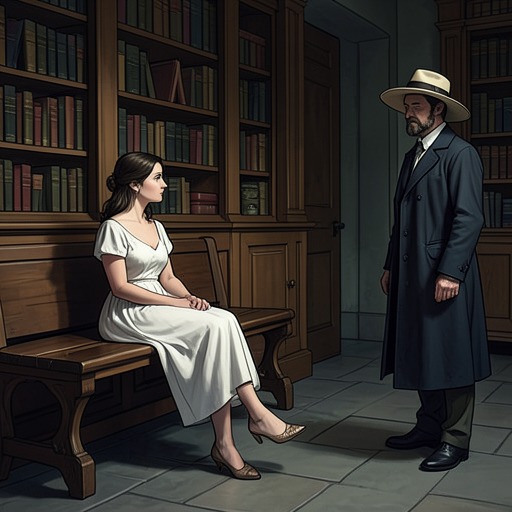
Rose’s unexplained intermittent paralysis
Hot MilkRose Papastergiadis’s unexplained, intermittent paralysis is both a bodily uncertainty and the organizing pressure of her relationship with her daughter, Sofia Papastergiadis. They travel to Spain seeking an explanation for Rose’s legs, but examinations, changing symptoms, and competing accounts never settle what is wrong. Rose’s capacity to walk appears and recedes; care is measured in water, medication, waiting, and the pace at which mother and daughter move together.
Identity and Clinical Uncertainty
When Sofia describes their reason for coming to Spain, she says that the family does not know whether Rose has limb paralysis. The problem has been going on for some time, and their first appointment at the Gómez Clinic is still three days away. Sofia has made her mother’s symptoms the focus of a long-running investigation: she says that she has been trying to decipher them for about twenty of her twenty-five years. Her childhood memory of Rose describing a headache as a door slamming in her head becomes part of that history, as do the new pains and treatments that repeatedly complicate any settled account.
The symptoms do not amount to a single, stable complaint. During Rose’s consultation with Julieta Gómez, Sofia hears that a case history must gather Rose’s account across childhood, past and present illness, and the future she anticipates. Sofia counts twenty complaints she has overheard, while recognizing that there were more. In this telling, Rose’s medical history does not unfold in a simple chronology: several times and complaints occupy the same account. That complexity helps explain why a label remains elusive; the narrative gives no definitive diagnosis for Rose’s intermittent difficulty walking.
Caregiving and the Pace of Walking
Rose’s changing mobility governs everyday routines as well as appointments. At home, she may wake and call for water, while Sofia tries different versions—chilled from the refrigerator, not chilled, or boiled and left to cool—without knowing which will be right. The small practical task captures how care depends on interpreting needs that are not always clear. The family has chosen a one-floor apartment near the local square partly because it has no stairs, and the uncertainty has led them to remortgage Rose’s house to pay the twenty-five-thousand-euro cost of treatment at the Gómez Clinic.
At the clinic, the receptionist summons Rose, and Sofia takes her arm as they limp together across the marble floor. Sofia is twenty-five, but she adjusts her stride to her mother’s, describing her own legs as becoming Rose’s legs. The scene is not a straightforward picture of permanent incapacity: earlier that morning, Rose had walked alone to the local Spar to buy hairpins without a walking stick. Sofia pushes that memory aside, but it remains evidence of the variation that makes the condition difficult to understand. Once the nurse takes over and pushes Rose in a wheelchair, Sofia feels relief at being able to walk without keeping pace with her mother.
That physical accommodation persists even when the two are apart. After walking on the beach, Sofia sometimes finds herself limping, as if her body remembers how she moves beside Rose. At the market she sees Rose swat a fly from her feet with a rolled-up copy of the London Review of Books. The fly’s landing is perceptible to Rose: Sofia realizes that her mother is not numb, but acutely sensitive. Later, Rose drives across the motorway to the market, moving her feet between clutch, brake, and accelerator despite telling Sofia that she has no feeling in her legs. Neither the act of driving nor the changing sensation supplies a diagnosis; together, they make the mismatch between reported impairment and observed movement more difficult to ignore.
Medical Encounters and Competing Explanations
The examinations produce specific findings without explaining the broader problem. Dr Gómez notices two ulcers on the sole of Rose’s right foot, one area slightly infected, and asks whether she has been tested for diabetes. Rose says she has. Dr Gómez also proposes reviewing her medication with her, asking which medicines she feels most attached to and which she could give up. The consultations thus attend not only to the legs but to the treatment routine that has grown around Rose’s many complaints.
During a later discussion, Dr Gómez tells Sofia that Rose’s walking appears in anger or grievance. He notes that she tripped on the way to a restaurant without straining, spraining, or fracturing anything, and says that the observation rules out osteoporosis, while expressing concern about the vitality Rose puts into not walking. He is uncertain whether he can help. A later X-ray complicates rather than resolves the assessment: Rose is losing bone density, but Dr Gómez says that this is normal for women over fifty and that she has not suffered significant loss of bone material. He recommends that she walk home.
The treatment dispute becomes more consequential when Dr Gómez tells Rose that continuing treatment requires stopping every medication, including pills for cholesterol, sleep, heart palpitations, indigestion, migraines, back pain, blood pressure, and pain. He also tells Sofia that administering her mother’s medication has become a ritual in both their lives and characterizes Rose as a shield protecting Sofia from making a life of her own. His interpretation makes the caregiving arrangement part of the clinical encounter, but it does not establish the cause of Rose’s symptoms. Later, Rose reports that she has described her condition as chronic and degenerative, while Dr Gómez has admitted knowing little about chronic pain; she says that the pain magnifies every day, though her feet do not hurt at that moment and are numb.
A clinic review brings another medical episode into view. Dr Gómez explains that Rose was admitted to hospital for two nights because she was dehydrated and received intravenous saline. He emphasizes that Rose cannot easily swallow water, and therefore cannot easily swallow her medication. Rose tells the reviewers that she is back on track after the hospital doctor in Almería also expressed concern. This later account sits beside the instruction to stop medication, showing how Rose’s treatment changes over time without making the underlying mobility problem clear.
Change, Ending, and Narrative Significance
The book’s account of Rose’s condition resists a simple progression from illness to recovery. Sofia’s interpretation shifts with what she witnesses: Rose may be in a wheelchair, walking alone, driving, or sensitive enough to feel a fly on her foot. Sofia herself sometimes adopts her mother’s limp, while Rose’s own account moves among symptoms, remembered history, and changing sensations. The uncertainty is not resolved by treating any one observation as the whole truth.
Near the end, after an emotionally painful encounter, Sofia sees Rose walking barefoot along the shore in a sunflower-patterned dress, carrying a hat. Rose appears content in her own company and does not see Sofia. She walks toward the shower ramp, and Sofia remains in the sea rather than approaching her. When Sofia eventually returns to shore, she searches for Rose’s footprints and draws a rectangle around the first two prints in the sand. The scene confirms that Rose is walking at that moment, but it does not explain why her mobility has been intermittent or establish that the condition is over. Her footprints preserve a specific instance of movement; the mystery, and the distance between mother and daughter, remain.